Botox, short for onabotulinumtoxinA and related botulinum toxin type A products, has been smoothing frown lines and softening crow’s feet for more than two decades. When used well, it looks like good sleep, not surgery. I have treated thousands of faces, and the through line is always the same: results hinge on a careful consult, precise dosing, and thoughtful aftercare. The journey from first conversation to refreshed glow is a series of small, well judged steps.
What Botox actually does
Botox injections temporarily relax targeted muscles by blocking the release of acetylcholine at the neuromuscular junction. In practical terms, the skin stops folding as forcefully, fine lines soften, and deeper grooves stop being reinforced. That is why botox therapy is considered both corrective and preventative. Think of it as a strategic pause for specific facial muscles, not a global shutdown of expression.
Most clinics use one of four main formulations for cosmetic use: onabotulinumtoxinA, abobotulinumtoxinA, incobotulinumtoxinA, or prabotulinumtoxinA. Units are not interchangeable between brands, and published conversion ratios vary. A provider accustomed to one product will factor this into the dosing. What matters for you is the clinical effect: natural motion at rest, reduced dynamic lines when you animate, and no heavy brow or frozen smile.
Many people use the phrase botox cosmetic treatment as shorthand for all wrinkle relaxing injections. Within the face, common targets include botox for forehead wrinkles, botox for frown lines, and botox for crow’s feet. Off the upper face, we might treat bunny lines on the nose, dimpling in the chin, or downturned mouth corners. The aesthetic goal is harmonized expression, not paralysis.
The first conversation sets the tone
A good consult is part anatomy lesson, part detective work. I want to know how you animate when you are happy, focused, or annoyed, and what features you see in photos that you want to change. I also look for what not to touch. Overactive frontalis muscles, for example, sometimes compensate for a heavy brow. If I switch off the forehead without supporting the brow, you can feel weighed down. The best botox facial treatment respects underlying structure as much as it addresses the lines on the surface.
During the visit we cover medical history, medications, and timing. If you have a wedding or photo shoot in eight to ten weeks, that rhythm is different from someone who wants subtle softening before a performance next month. I document baseline photos and sometimes a short video while you animate, which helps me refine placement on future visits.
Here is a brief checklist I give new patients to help steer a productive consult.
- What specific lines or expressions bother you the most, and in which settings do you notice them? How do you feel about movement, and what level of softening looks natural to you? Are there headaches, eye strain, or jaw tension that might improve with botox muscle relaxing injections? What is your calendar for the next two weeks, including travel, events, or intense workouts? Which medications, supplements, or past treatments might affect bruising, healing, or results?
A candid discussion about what botox wrinkle treatment can and cannot achieve saves frustration later. Fine etched lines at rest sometimes need more than muscle relaxation, especially if the skin has thinned from sun exposure or smoking. In those cases, I pair botox cosmetic injections with skin quality work such as microneedling, light peels, or energy based devices. That is how you get true botox skin rejuvenation rather than a single purpose treatment.
Who is a candidate, and who should wait
Botox injections suit adults with dynamic facial lines, meaning wrinkles that appear or deepen when you animate. Typical ages range from late twenties to seventies. Preventative botox for fine lines is better framed as preemptive fine tuning in areas with strong muscle pull and early creasing. A person with expressive frown lines by 28 might benefit from light dosing, while someone at 38 who barely frowns may not need it yet.
There are clear reasons to defer treatment. Active skin infection in the target area, pregnancy, and breastfeeding are standard pauses. I also take care with neuromuscular disorders like myasthenia gravis, certain anticoagulants that cannot be held, and recent facial surgery where healing could be affected. If you have a history of keloids or unusual scarring, botox itself is not the culprit but needles still pierce skin, so we choose entry points with care.
Mapping the face, not painting by numbers
Cookie cutter dosing leads to cookie cutter faces. In real life, most brows do not sit at the same height, and one eye often opens more than the other. I start with a conversation about your preferred brow shape, then I map muscle function layer by layer.
- Frontalis, the forehead elevator: too much botox for forehead wrinkles here can flatten expression or drop the brow. Light, high placed dosing preserves lift. Many women land between 6 and 16 units total. Heavier brows or large foreheads might need 10 to 20 units. Men often need more due to muscle bulk. Glabellar complex, the frown line trio: corrugators and procerus pull the brows inward and down, creating the 11s. Classic on label dosing hovers around 20 units, with ranges from 10 to 30 depending on sex, muscle strength, and goal. This is where botox for frown lines creates that relaxed, less stern appearance. Lateral canthus, or crow’s feet: for botox for crow’s feet, a typical plan uses 6 to 12 units per side spread over two to three points, placed to avoid smile distortion. Nasalis bunny lines: 4 to 8 units across the upper nose softens scrunching that etches oblique lines. Depressor anguli oris at mouth corners: 2 to 6 units per side can soften a persistent downturned expression, but caution is key to keep smile mechanics intact. Mentalis, the chin: 4 to 8 units relax a pebbled or dimpled skin surface, a subtle but satisfying fix.
These are not promises, they are starting points. A light first pass paired with a touch up two weeks later is often the safest route to a natural result. Over time, as we learn how your face responds, dosing becomes more predictable.
The treatment day, minute by minute
Most people are surprised by how quick a botox procedure is. Plan 20 to 30 minutes if it is your first visit and closer to 10 for maintenance. I prefer clean, makeup botox Pensacola FL free skin to reduce the risk of folliculitis or clogged pores after injections. I mark while you animate, then clean with alcohol or chlorhexidine. A small needle - often 30 or 32 gauge - delivers tiny aliquots. Each injection feels like a quick pinprick. Many patients skip topical anesthetic because the process is so fast, but for needle sensitive folks a few minutes with a numbing cream helps.
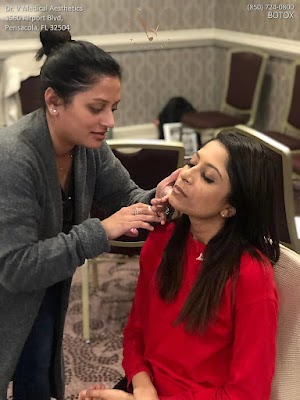
A very small volume is used per site, which is why bumps fade within minutes. I keep gauze nearby not for bleeding, which is minimal, but to apply gentle pressure if a vessel is nicked. If you bruise easily, arnica or bromelain might be suggested. Avoiding fish oils, high dose vitamin E, and alcohol for a couple of days around treatment can reduce bruising risk. These tips are not rules, but they help.

One clinical pearl: placement matters more than absolute dose. One extra millimeter too low in the frontalis can cause a heavy brow in someone with low set brows, while half a unit too high might do nothing. Precision and restraint are different skills, and both are necessary for elegant botox aesthetic treatment.
What it feels like afterward
Right away, you look the same aside from the slightest redness that resolves in an hour or so. The medication does not work instantly. Most people start to feel botox wrinkle smoothing between day two and day four, with full effect by day 10 to 14. You can see the timing in your expression. The brow stops knitting together. Crow’s feet soften during big smiles. The forehead moves but does not crease as sharply.
I ask patients to keep their head above heart for four hours and skip intense exercise, saunas, and face down massages for the rest of the day. That conservative guidance aims to minimize diffusion into nearby muscles. High quality data on posture rules are limited, but in practice these habits help reduce edge case complications such as brow or eyelid heaviness.
Here is the aftercare I hand out, trimmed to the essentials.
- Stay upright for four hours and avoid pressing or massaging treated areas. Skip strenuous workouts, hot yoga, or saunas until tomorrow. Keep skin clean and hands off your face the first evening. If you bruise, use a cool compress for 10 minutes a few times the first day. Book or confirm your two week review so we can fine tune if needed.
Common, uncommon, and rare side effects
Expect a couple of small injection site marks that fade within the hour. Mild headache can happen in the first 24 to 48 hours, more often after first time treatment or in the forehead. Bruising occurs in a minority of cases, anywhere from 5 to 20 percent depending on the area and your individual tendency. A single pinpoint bruise near the crow’s feet is the most common, and it is easy to conceal.
Eyelid ptosis, a drooping upper lid, is uncommon with modern technique. Published rates vary around 0.5 to 2 percent in glabellar treatments, and risk climbs with lower injections near the levator palpebrae. If it happens, it is temporary. Apraclonidine or oxymetazoline drops can offer a small lift while the effect wanes over two to six weeks. Brow heaviness is more common than eyelid ptosis and usually reflects either over dosing the frontalis or poor balance between elevators and depressors. That is why a conservative first pass and precise mapping matter.
Smile asymmetry is rare when treating crow’s feet or the DAO, but if toxin spreads to the zygomatic complex, the upper lip can feel different for a few weeks. Dry eye can occur if lateral canthal dosing over relaxes the blink. On the flip side, some patients notice fewer tension headaches or jaw clenching with strategic botox muscle relaxer treatment in the temples or masseters, though those are off label uses in some regions.
Allergies to the toxin itself are rare. Most so called reactions are actually vasovagal episodes or anxiety related. To be safe, I observe first time patients a few minutes before they leave.
How long botox lasts, and what influences it
The effect of botox facial injections typically holds 3 to 4 months in the upper face. Some first timers peak early and fade by 10 to 12 weeks. Repeat treatments often last a little longer as muscle memory softens and you unlearn overactive expressions. Athletes who do frequent high intensity training sometimes metabolize quicker. Heavier muscle mass, smoking, and baseline sun damage also tilt the curve.
I schedule a follow up around two weeks to check symmetry and function. If a crease still activates too strongly, we add a small top up, often 1 to 4 units. Beyond 30 days, I prefer to wait for the next cycle so we can assess true duration.
On natural results, and why frozen faces happen
The fear of looking odd keeps some people away from botox cosmetic therapy. The truth is that a stiff or overarched look is a choice, not a foregone conclusion. It usually happens when the frontalis is suppressed across the whole forehead without supporting the brow position, or when the lateral brow is lifted too aggressively. These are correctable with more nuanced mapping.
A natural botox face treatment allows the apex of the brow to rise slightly when you emote, the eyes to smile, and the forehead to show a whisper of motion that matches your age and style. This is where artistry meets anatomy. During your consult, show me photos where you love how you look. Those cues are as important as any measurement.
When lines at rest need more than muscle relaxation
Deeply etched lines will soften with botox wrinkle reduction, but they may not vanish. Skin that has folded in the same place for years can retain a fine groove even when the muscle rests. Here, pairing botox cosmetic wrinkle treatment with targeted skin support makes a visible difference. Microneedling series, fractional lasers, light TCA peels, and consistent topical retinoids improve texture and collagen. If a true crease remains, a tiny thread of hyaluronic acid filler laid superficially can finish the job. This is not about volume, it is about line correction. When done well, it looks like smooth, healthy skin rather than a filled crease.
Preventative dosing vs chasing lines
Preventative botox anti aging treatment is not a mandate in your twenties. It helps when two conditions meet: you have strong dynamic motion in a small area, and you can already see makeup settling into lines by day’s end. A few well placed units two or three times a year can slow the formation of etched lines. If your skin is resilient and your animations light, skincare and sun protection may be enough for now. Good clinicians talk patients out of unnecessary botox anti aging injections as often as they advise them.
Cost, value, and planning your year
Pricing varies by market, injector experience, and brand. Some clinics price per unit, others per area. Unit prices in many US cities range roughly from 10 to 25 dollars. A typical upper face treatment could use 30 to 50 units depending on goals, sex, and muscle strength. That puts a cycle in the mid hundreds to low thousands. Maintenance every 3 to 4 months is common early on, then some patients stretch to 4 to 6 months once a rhythm is established. It is worth asking about loyalty programs tied to specific brands, which can shave down cost across the year.
If you are planning events, work backward. For a wedding, treat 6 to 8 weeks before the day so you can adjust at the two week visit and settle into the sweet spot by weeks four to six. For photography that demands expression, keep some forehead motion and focus on the 11s and crow’s feet, which read harshly on camera.
How to choose the right injector
Credentials matter, but so does philosophy. Ask to see unfiltered before and after photos that match your age, sex, and features. Look for consistent brow shapes and balanced smiles. Providers who listen closely and recommend a staged plan tend to deliver better botox cosmetic face treatment outcomes than those who promise perfection in one pass. If an office pushes a template like flat foreheads for everyone, that is a red flag.
I also pay attention to how a clinic handles small problems. Do they welcome a short follow up to tweak a stubborn line, or do they dismiss concerns as nitpicking? Attention to detail is a reliable predictor of safe, elegant botox facial rejuvenation.
A few cases that illustrate judgment
A musician in her mid thirties arrived with intense frown lines that made her look stern on stage. She feared a frozen forehead because she needed expressive brows when she performed. We treated the glabella with 18 units, feathered 6 units high on the frontalis to maintain lift, and placed 8 units per side near the crow’s feet. At two weeks she had softer 11s, still arched her brows when she emoted, and her smile looked unchanged. Over three cycles, we nudged the glabella up to 22 units as her muscle pattern relaxed. Her band photos look like her, just less tense.
A software engineer in his forties hated a single deep crease running across his mid forehead. He had trained his frontalis to overcompensate for mild brow heaviness. We used 14 units spaced high to avoid dropping the brow and left the lower third of the frontalis active. The line softened but remained faintly visible at rest. We added a very conservative microdroplet of filler into the crease at visit two. At three months, with sun protection and nightly retinoid, the crease read as normal texture, not a line.
These are everyday examples of botox wrinkle management treatment that respects function first. Neither patient looked overdone. Both felt more like how they feel on the inside.
What if you stop
Botox is not a forever contract. If you skip a cycle, muscles gradually regain full function over 3 to 6 months. Lines will return to baseline or a bit better if you kept good skincare and sun protection. There is no rebound worsening; you are not stretching a spring. Some people use botox wrinkle prevention for a few years, refine their habits, then return only before major life events. Others treat like clockwork because the mirror tells them it is worthwhile. Either approach is reasonable when it is an informed choice.
Final thoughts from the treatment chair
Botox cosmetic injections treatment is at its best when it disappears into your life. Colleagues may note you look rested after a long week. Friends may ask about your skincare. You will feel less compelled to knit your brows during concentration. That subtle shift changes how others read your mood, and over time that can change how you feel about your own reflection.
If you are considering botox wrinkle injections or broader botox skin treatment, give the consult as much weight as the needle time. Bring your questions. Share the photos you like. Ask about unit plans rather than areas. Understand the arc from day one to day fourteen, and how we will make small adjustments. A good plan blends botox wrinkle reduction injections with skin health so that six months from now your face does not just move better, it looks better.
I often tell patients that botox wrinkle therapy is a scalpel, not a sledgehammer. Used precisely, it carves away the tension that creases the face. Paired with sound skincare, sun sense, and a light touch with other procedures, it delivers a quiet, durable glow. That is the point of botox facial wrinkle treatment, botox line smoothing treatment, and the broader world of botox cosmetic wrinkle management: not to change who you are, only to let your best expressions come through with less static.